
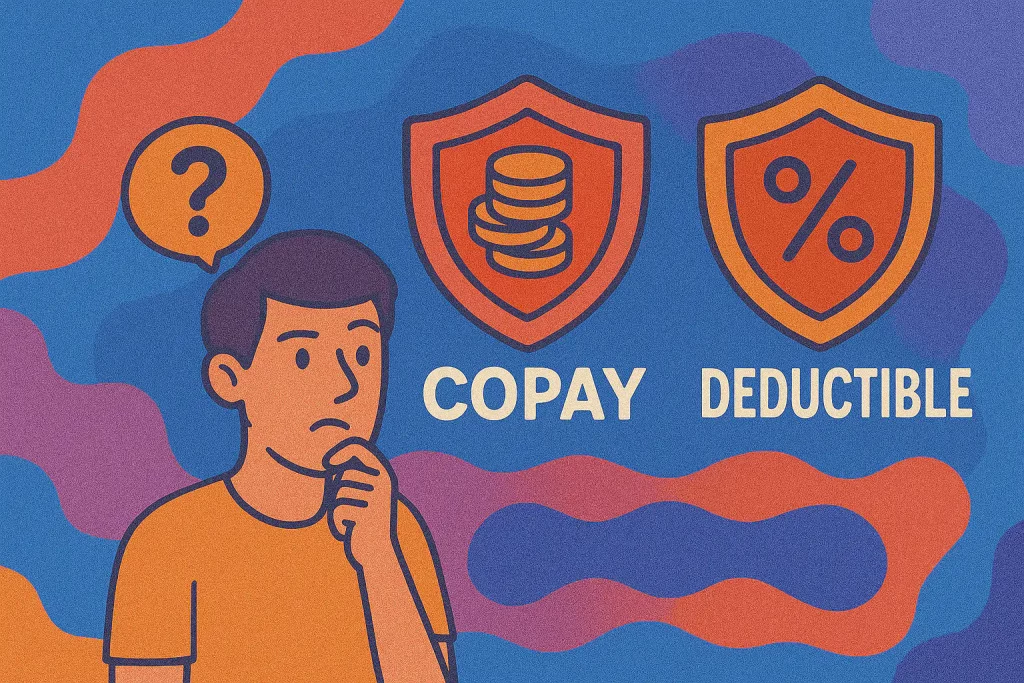
Copay vs Deductible vs Coinsurance: Breaking Down Your Health Insurance Costs
Copayment vs coinsurance represents the fundamental difference between fixed-fee healthcare payments and percentage-based cost sharing, with copays requiring specific dollar amounts ($25 doctor visits) while coinsurance demands percentages of total costs (20% of $5,000 surgery). Understanding this distinction determines your out-of-pocket exposure and budget predictability for medical expenses throughout the plan year.
What is Zero Deductible Health Insurance?
Zero deductible health insurance activates coverage immediately for all services without requiring upfront out-of-pocket payments before insurance benefits begin, though premiums typically cost 40-70% more than plans with $1,000-3,000 deductibles. These plans benefit high healthcare users requiring frequent specialist visits, prescription medications, or ongoing chronic condition management where predictable costs outweigh higher monthly premiums.
Hidden Zero Deductible Scenarios: Preventive care receives zero deductible coverage across all health insurance plans regardless of overall deductible amounts, including annual physicals, immunizations, mammograms, and colonoscopies that activate 100% coverage without deductible requirements. Specific services like emergency room visits may bypass deductibles in certain plans, applying only copays or coinsurance to reduce financial barriers during medical emergencies.
What is a $0 Deductible in Health Insurance?
A $0 deductible in health insurance means insurance coverage begins immediately for all medical services without requiring any out-of-pocket payments before benefits activate, contrasting sharply with traditional plans requiring $1,500-8,000 annual deductibles before coverage starts. The premium trade-off calculation becomes critical, as $0 deductible plans cost $200-400 more monthly than high-deductible alternatives, creating annual premium differences of $2,400-4,800.
Break-Even Analysis: $0 deductible plans make financial sense when annual medical expenses exceed $5,000-8,000, including regular specialist visits, ongoing medications, or planned surgeries where immediate coverage activation provides greater value than premium savings from high-deductible plans.
HSA Eligibility Loss: $0 deductible plans eliminate Health Savings Account eligibility that requires minimum deductibles of $1,600 individuals or $3,200 families, losing triple tax advantages worth thousands annually in pre-tax contributions, tax-free growth, and tax-free medical expense withdrawals.
Copay vs High Deductible: The True Cost Reality
High deductible health plans require $1,600-8,000 annual out-of-pocket payments before coverage activates but offer 30-50% lower monthly premiums plus HSA eligibility worth $4,300-8,550 in annual tax-advantaged contributions. Copay-based plans provide immediate predictable costs for doctor visits and prescriptions but eliminate HSA benefits and cost significantly more in monthly premiums.
The Unexpected Expense Trap: Copay plans appear affordable with $25-40 doctor visit fees until major procedures reveal 20% coinsurance obligations on $50,000 surgeries creating $10,000 out-of-pocket costs. High deductible plans cap total annual exposure at defined out-of-pocket maximums ($9,450 individuals) regardless of service costs, providing superior catastrophic protection despite higher upfront costs.
Chronic Condition Calculations: Diabetes patients requiring monthly endocrinologist visits ($40 copays x 12 = $480) plus prescriptions ($150 monthly = $1,800) spend $2,280 annually in copay plans before any deductible requirements, while high deductible plans may provide lower total costs through HSA-funded expenses and deductible satisfaction that activates full coverage mid-year.
Health Insurance Terminology 101: The Cost Structure Hierarchy
Primary Out-of-Pocket Components: Premiums represent monthly insurance fees paid regardless of healthcare usage, deductibles require annual thresholds before coverage activates, copays demand fixed fees for specific services, coinsurance splits remaining costs through percentages, and out-of-pocket maximums cap total annual expenses including all previous components.
Cost Application Sequence: Pay premiums monthly to maintain coverage, meet annual deductibles before most coverage begins, pay copays or coinsurance for covered services, until reaching out-of-pocket maximums that trigger 100% insurance coverage for remaining plan year expenses.
Preventive Care Exception: Preventive services bypass the normal cost sequence entirely, receiving 100% coverage without premiums counting toward care costs, no deductible requirements, no copays, and no coinsurance obligations regardless of plan type or deductible levels.
Strategic Plan Selection by Usage Pattern
Low Usage Strategy (Under $2,000 annual expenses): Choose high deductible plans with $1,600-3,000 deductibles to minimize monthly premiums, maximize HSA contributions for tax advantages, and accept deductible responsibility for infrequent medical needs that rarely exceed upfront thresholds.
Moderate Usage Strategy ($2,000-8,000 annual expenses): Select mid-range deductible plans ($1,000-2,000) balancing monthly premium costs with reasonable deductible exposure, providing coverage activation when medical needs arise without excessive premium waste or catastrophic deductible obligations.
High Usage Strategy (Over $8,000 annual expenses): Opt for low or zero deductible plans despite higher premiums, as frequent medical services, ongoing medications, and specialist care create consistent expenses where immediate coverage and predictable copays provide superior value than premium savings.
Coinsurance Calculation Secrets
The 80/20 Standard Trap: 80/20 coinsurance appears favorable until applied to expensive procedures, where $100,000 cancer treatments create $20,000 patient obligations that exhaust savings and create medical debt despite having insurance coverage.
Out-of-Pocket Maximum Protection: All coinsurance payments count toward annual out-of-pocket maximums ($9,450 individuals, $18,900 families in 2024), limiting total exposure regardless of treatment costs and providing essential catastrophic expense protection that deductibles alone cannot offer.
Network Coinsurance Variations: In-network coinsurance typically runs 10-20% while out-of-network coinsurance jumps to 30-50%, creating massive cost differences for identical services based solely on provider network participation that many patients discover only after treatment completion.
Advanced Cost Minimization Tactics
January Medical Scheduling: Schedule expensive procedures in January after deductible resets to maximize current-year insurance benefits while preserving previous year remaining coverage for unexpected treatments, optimizing benefit utilization across plan years.
Out-of-Pocket Maximum Acceleration: When facing major medical expenses exceeding annual deductibles, cluster additional needed treatments within the same plan year to reach out-of-pocket maximums triggering 100% coverage rather than spreading expenses across multiple years requiring separate deductible payments.
Preventive Care Maximization: Utilize 100% covered preventive services for early detection and routine maintenance that prevents expensive treatments requiring deductibles, copays, and coinsurance obligations while maintaining optimal health through regular monitoring.
Family Policy Cost Structure Complexity
Individual vs Family Deductibles: Family plans feature both individual deductibles ($1,500-3,000 per person) and family aggregate deductibles ($3,000-6,000 total), creating scenarios where one family member’s expenses satisfy family deductibles activating coverage for all members without additional individual deductible requirements.
Embedded Deductible Protection: Embedded deductibles cap individual exposure at individual deductible amounts even when family deductibles remain unsatisfied, protecting families from scenarios where single members face excessive costs while family aggregate thresholds haven’t been met.
Copay Accumulation Rules: Copays may or may not count toward deductible and out-of-pocket maximum calculations depending on plan structure, creating significant cost variation between plans with identical copay amounts but different accumulation rules affecting total annual expenses.
Prescription Drug Cost Considerations
Formulary Tier Impact: Prescription copays vary dramatically by drug tier, with generic medications costing $5-15, preferred brands $30-50, non-preferred brands $70-150, and specialty drugs requiring 20-33% coinsurance on prices exceeding $3,000-10,000 monthly.
Deductible Application Variations: Some plans apply prescription costs toward medical deductibles while others maintain separate prescription deductibles, creating significant coverage timing differences affecting when drug costs receive insurance benefits versus requiring full out-of-pocket payments.
Comparing Group Policies and Individual Policies
Group policies through employers typically offer lower deductibles ($500-2,000) with predictable copays and employer premium contributions subsidizing 70-85% of costs, while individual policies purchased through marketplaces feature higher deductibles ($3,000-8,000) but provide income-based subsidies reducing premiums for qualifying households.
The choice between copay-focused plans and high deductible options depends on expected healthcare usage, chronic condition management needs, and financial capacity to handle large unexpected medical expenses. Whether selecting individual policies, family policies, or group policies, understanding the interaction between premiums, deductibles, copays, coinsurance, and out-of-pocket maximums enables strategic plan selection that minimizes total healthcare costs.
EXCELLENT Based on 176 reviews
 Posted on Google
 Ethan DKnowledgable, Super efficient, honest, and easy to work with. She also has a vast network of resources. Highly recommend you have a chat with Jenn.Posted on Google
 Christina WalzDealing with any form of insurance is daunting but Jenn made this painless and an actual joy! She’s so thorough and provides outstanding service, I’m so appreciative of her!Posted on Google
 Lisselotte HernandezJenn is the best agent, she help me to enroll easily the insurance She has a exceptional good customer service and answers questions and the phone right awayPosted on Google
 Anahi CarreonJenn was very helpful when looking for a plan and understanding with working around my busy schedule. I also really appreciate whenever you have a question she will get back to you as soon as possible. She has been a big help!Posted on Google
 Siu PoonExtremely friendly and personable, easy to work with, and very knowledgeable in her field. Thx!Posted on Google
 Kim ChitwoodJenn was fantastic. Patient and informative. She walked me thru the entire process and made it so easy for me. The money she saved me is amazing. Thank you Jenn!Posted on Google
 Skylar SchultzJenn Voss was an amazing help to me as a rep for Integrity Health Insurance. She understood exactly what I needed and was able to find me a package that took good care of me all while staying in my price range! I would recommend this to anyone in my field of work a million times over. Thank you so much Jenn for making this process so easy!Posted on Google
 Robert ZuckerI recently worked with Jenn Voss at Integrity Health Insurance to find private health coverage, and I couldn't be more pleased with the experience. Jenn took the time to really understand my needs and walked me through my options clearly and patiently — no pressure, just genuine guidance. She made what can be a stressful and confusing process feel completely manageable. I left feeling confident I had the right plan for my situation. If you're navigating the world of private health insurance, Jenn is exactly who you want in your corner. Highly recommend!Verified by TrustindexTrustindex verified badge is the Universal Symbol of Trust. Only the greatest companies can get the verified badge who has a review score above 4.5, based on customer reviews over the past 12 months. Read more
Learn More
Ready to secure optimal health coverage?
Contact Integrity Health Insurance today for your personalized health insurance analysis and instant quote comparison across all available plans in your area.